
Buried: 07/12/1863, aged 63
Plot no: 11430 | Section: E06 / G2
Samuel Pitman was born in Somerset on 12 September 1787 and was baptised at St James Taunton on 29 September that year. He was the eldest child of James and Mary Pitman. Trowbridge and Bradford had been known as centres for the cloth industry from the 14th century and it was here that Samuel’s father and then Samuel were wool weavers.
The banns (a public announcement of the intention to marry) of Samuel Pitman and Maria Davis were read in their local church in Trowbridge, in May 1807; although the couple did not marry until 17 April 1808. The couple remained in Trowbridge and over the following eighteen years had eleven children. All the children were baptised at St James & St Stephen although at the same time it would appear that at least some of the family were attending Baptist meetings.
Samuel was the overseer in the extensive cloth factory owned by James Edgell, becoming manager of the cloth mill before established a factory of his own and setting up his own clothier business. His second son, Isaac, also worked at the cloth factory; starting as a clerk in the counting house, at the age of 13.
Samuel and Maria’s fourth son, Benjamin, died in June 1829, aged 7. He was buried in Chapmanslade, Wiltshire and is commemorated on the headstone at Abney Park Cemetery. Later that year a fire spread rapidly through the building that Samuel and others occupied; within a couple of hours it was ‘a mass of ruins.’ The report in the Dorset County Chronicle reported that:
’The fire was, no doubt, occasioned by the natural heating of some flocks, called engine waste, which had been carelessly left by the workmen; the more to be deplored, as Cautions had been left at most of the shops in the town, and posted up in various places, announcing the fact that “flocks with which train-oil is used, will take fire in a few hours”.
The following April, Samuel’s premises were ‘entered by means of false keys’ and some of his cloth was stolen. He offered a £15 reward ‘for the discovery of the thief or thieves’. Whether the perpetrators were found is not reported but, when in 1836 Samuel was the victim of another robbery, the thief was charged and sent to Fisherton Gaol, Salisbury.
By the time of the 1841 census, Samuel and Maria were living in part of Kingston House, Bradford, Wiltshire. Almost certainly part of the building was used for storing cloth. Another part of the house was occupied by a cloth worker and his family. The house was owned by Thomas Divett who worked in the City of London. He had built a cloth mill, but the cloth industry was in decline and the house was put up for sale in 1848.
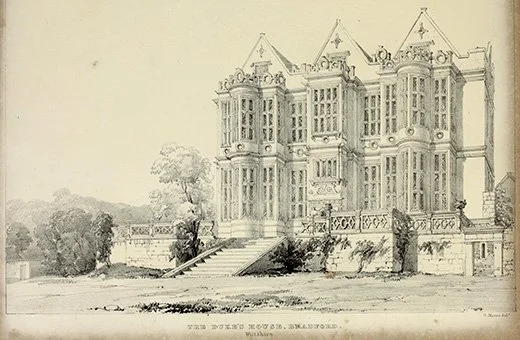
Kingston House, 1837. By C. J. Richardson. (Public domain - commons.wikimedia)
Life in London
At the time of the census in 1851, Samuel and Maria, with their daughters Rose and Mary, were living with their youngest son Frederic in Lambeth. Frederic had married a few months earlier but his wife, Elizabeth, had died. He was 22 and working as a bookseller. Mary was an assistant in the business. Samuel was not working; his occupation was listed as ‘formerly cloth manufacturer’. Maria and Rose were mistresses in a public School.
Maria Pittman died in 1854 in Islington. By this time, her son Isaac was well-known, and the death notice identified her as the mother of Isaac, ‘author of “Phonography’. She was buried at Abney Park Cemetery on 6 July, a cloudy showery day.
With his sons all involved with promoting Isaac’s phonography, and his daughters contributing to the private shorthand family paper Samuel decided to learn the system so he could read the articles published. Samuel joined Frederick in the bookselling business and was living in Clerkenwell. When, on 12 November 1857, he married Eliza Darton from South Hackney the newspaper announcement identified him as ‘father of the inventor of Phonography’. Eliza’s father was a bookseller so it is probable Samuel met her while working for his son.
At the time of the 1861 census the couple were living at 1 Heber Place, Hackney, near St Thomas’s Square. Samuel had changed his occupation and was working as a toy dealer. Samuel’s daughter, Rosella was living nearby in Bethnal Green and was a teacher at the British School in Ramsey Street.
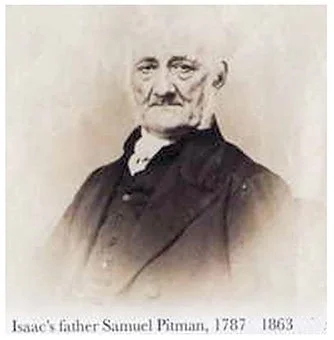
Samuel Pitman, date unknown.
Samuel died in Hackney on 2 December 1863. Death notices in the newspapers gave more information about his life. The Wiltshire Times & Trowbridge Advertiser noted:
‘He was formerly a clothier, and carried on business at the Silver Street Factory, Trowbridge. Deceased was highly respected and lived to see his sons devote their lives successfully to the writing and printing reform – Phonology and Phonotopy.’
The Huddersfield Chronicle reprinted an entry form the Phonographic Magazine:
‘Death of Samuel Pitman, Esq., Father of the Inventor of Phonography. — We have received, says the Phonographic Magazine, the intelligence that Samuel Pitman, the venerable father of Isaac Pitman and the Pitman family, has been gathered to his fathers at the ripe age of 76. A man of great good sense, probity, and honour; active in thought, and apt of hand; practical rather than poetic; a truly religious man, but religious in life rather than in the observance of forms. He never uttered an oath; and was incapable of idle talk or profanity. He was neither demure nor gloomy, but always general, sensible and dignified. He was strict with his children, but it was the severity of justice. He never reproved or punished in anger. He was one of the pioneers of popular education, and was first to move in the establishment of schools in his own town. He was an energetic and effective labourer in this field of reform when such a course subjected him to contumely and scorn. He learned phonography so as to read it easily and write it correctly when nearly 65 years of age. He thought it would be a shame to leave the world ignorant of his son's invention. Of his eleven children, ten still live to remember his love, and bless his memory.’
Samuel was buried at Abney Park Cemetery on 7 December 1863, in the grave with his first wife, Maria.
Sir Isaac Pitman
Isaac, later Sir Isaac Pitman, was born in 1813. After working as a clerk in the counting house of the firm his father worked for, he taught in Lincolnshire and Gloucestershire but was dismissed from the latter post when he joined the New (Swedenborgian) Church. He settled in Bath with his wife, Isabella, and their children. He learnt a style of shorthand and then adapted it using phonetics as the basis for spelling. Over ten years he worked on improvements to the system, first presenting it in 1837; soon it was the tool used first by reporters and then in many offices. Pitman shorthand was the most popular shorthand system used in the United Kingdom and the second most popular in the United States.
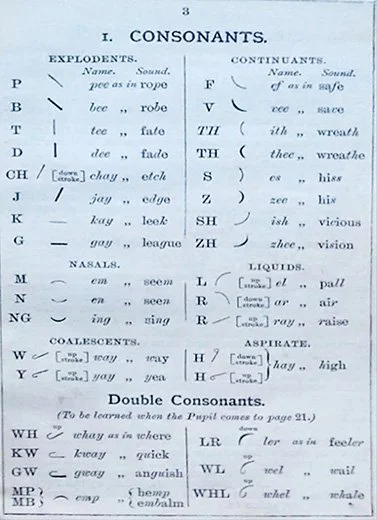
An example of Pitman shorthand. Taken from a book published during the 1890s.
One characteristic feature of Pitman shorthand is that unvoiced and voiced pairs of sounds are represented by strokes which differ only in thickness; Pitman shorthand also uses straight strokes and quarter-circle strokes, in various orientations, to represent consonant sounds. As well as spelling reform, Isaac was an advocate of teetotalism, vegetarianism (he was vice-president of the Vegetarian Society) and peace causes. He died in 1897 and a memorial plaque was placed in Bath Abbey.
Jacob Pitman
Jacob, the eldest son, was born in 1810. He helped at the Zion Baptist Chapel that his parent attended and was apprenticed to a local builder. He worked for Cubitt & Co in London (the company of millwright and civil engineer, Willam Cubitt), before training at the British and Foreign Bible Society. He taught in Gloucestershire and married Emma Hooper there. The couple, with their two children, sailed to Australia in 1837 and he set up as an architect and builder in Adelaide. As well as his involvement in the construction of several bridges, he founded the first society of the New (Swedenborgian) church in Australia and officiated as minister. He and continued to promote his brother’s system of phonology and taught the skill in several states. He died in 1890 and the inscription on his headstone includes an epitaph in Isaac Pitman's reformed spelling, describing Jacob as an 'arkitekt' who 'introduist fonetik shorthand'.