
Buried: Between 1887 and 1910
Plot no: 80525 / 80526 / 80527 | Section: E04 / H1
Six of the twelve women buried in these graves have either records or inscriptions linking them to the Mildmay Mission, either by address or profession (nurse or Deaconess). Three others (possibly retired) have Mildmay Park addresses adjacent to the Mildmay campus. That they had worked, in some capacity, for the Mission seems likely. Two of the deceased are memorialised as Deaconesses and one as a faithful nurse at the Mildmay Invalid Home. Four are recorded at addresses linked to the original Mildmay Mission and three are recorded at 68/70 Mildmay Park.
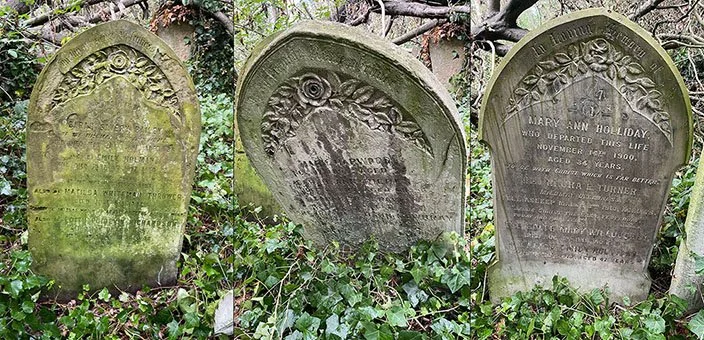
The three headstones of the Deaconesses, photographed individually. (© Abney Unearthed)
Buried in the three graves are:
Elizabeth Barnes; buried in 1887. Sarah Lavery Bailey, of Conference Hall, Mildmay Park; buried in 1891. Emily Holman, of The Memorial Cottage Hospital, Mildmay Park; buried in 1892. Matilda Whiteman Thrower, of 70 Mildmay Park; buried in 1902. Mary Sherring Harwood, of 68 Mildmay Park; buried in 1895. Sarah Ann Riches, of 68 Mildmay Park; buried in 1895. Sarah Ellen Musgrave, of Dace Road, Victoria Park; buried in 1896. Margaret Mathison Mowbray; buried in 1900. Mary Holliday, of Memorial Cottage Hospital, Mildmay Park; buried in 1900. Edith Poidevin Richardson; buried in 1902. Laura Elizabeth Turner, of Highbury Quadrant; buried in 1910. Edith Mary Willoughby, of Mildmay Memorial Hospital; buried in 1910.
According to the burial records, these plots appear to have been purchased by Catherine Pennefather; this may point to the deceased having no family to attend to their burials, or no estate to secure an entire burial plot. Could this have been a final charitable provision by their founder?
The Mildmay Mission
In 1857 The Rev William Pennefather, with his wife Catherine, had set up the Association of Female Workers based at Mildmay Park, Newington Green. The Association provided an outlet for the energies and abilities of women who had a social conscience. Women were trained in a variety of subjects, one them being nursing. Known as the ‘Mildmay Deaconesses,’ at this time they were self-funded women; predominantly from the upper classes.
The Mildmay Mission was founded in 1860 and grew radically after 1864 when Rev Pennefather and Catherine moved to St Judes, Islington. Between 1869 and 1885 a headquarters, a Conference Hall, a cottage hospital, a lecture hall, student houses, deaconess houses (for the trained nurses) and a nursing home were established around Newington Green and Mildmay Park.
In 1866 there was a cholera outbreak in East London. Two Mildmay Deaconesses, trained in nursing by Catherine, volunteered to go into the Old Nichol, in the East End to care for the sick and their dependents. The Old Nichol was situated between Shoreditch High Street and Bethnal Green Road and was one of the most notorious slums of the nineteenth century; even the police feared to enter. It consisted of 20 narrow streets containing 730 dilapidated terraced houses which were inhabited by some 6,000 people. The colour-coded maps of Charles Booth that showed the wealth or deprivation of London areas, painted the Old Nichol black; the denomination for the poorest and most crime-ridden.
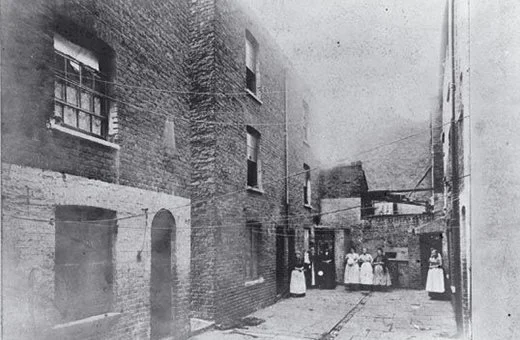
Boundary Street, 1890. (Public Domain, commons.wikimedia.org)
The work of the Deaconesses developed and expanded, even after William died in 1873. This meant that in 1877, Catherine, already President of the Association of Female Workers, continued to grow the charitable enterprise; establishing the Mildmay Medical Mission in Shoreditch. This was in a disused warehouse in Cabbage Court (now Bacon Street). It consisted of twenty-seven beds in three wards, one doctor, three nurses and five deaconesses in training. This was the first embodiment of what was to become Mildmay Mission Hospital. Catherine administered a personal approach; with dignity to everyone who came into her care, despite many of those people living in the most deprived conditions.
Slum clearances during the 1880s and 1890s meant that in 1892, the Mildmay Mission moved to purpose-built premises on Austin Street, Bethnal Green. This was a fifty-bed hospital with three wards. Although it did not discriminate by religion, throughout its existence the Mildmay Medical Mission stressed its role as an evangelical Christian centre as well as a general hospital; prayers were held on the wards, and biblical quotations were painted on the walls. Staff regarded their work as a religious as well as a medical vocation.
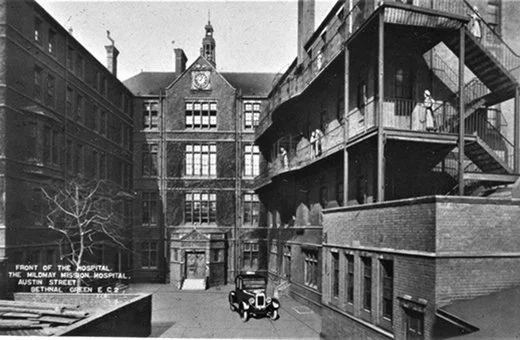
The Austin Street premises, 1892. (Unknown author. Public Domain, commons.wikimedia.org)
The Deaconesses
The Deaconess House adjoined the Conference Hall, with about forty deaconesses in residence. The house was bright and pleasant, with a large room for devotional services or various meetings, and a very spacious drawing room. Each deaconess had her own room or cubicle. The rules of the house were very simple; no vows are taken, but it was expected that love and devotion will keep the residents at their appointed tasks. Ladies were expected, if it was in their power, to pay £50 per year for board. Many who could not do this were accepted according to their circumstances. Some received a small allowance for personal expenses.
The women were all dedicated and trained in mission work, nurse training, theology, education, domestic duties. They performed charitable duties and parochial outreach throughout the East End and Islington. After two years, they would be trained in nursing and basic medicine to gain Deaconess status. The women would have considered the work vocational and foregone marriage and family life for their calling. Doubtless, the nature of the work and the communal nature of their domestic circumstances created a strong family ethos.
The Mildmay deaconesses worked under the clergy in fifteen London parishes. They were engaged in devotional exercises at home, and also in house-to-house visitation in the very poorest districts; paying between forty and fifty visits a week. Each deaconess, as a rule, had charge of a mothers' meeting in her district, as well as some having charge of girls' clubs, boys' clubs, and other work amongst children.
Mildmay’s Later Years
The Mildmay Medical Mission was incorporated into the National Health Service (NHS) in 1948 and continued to operate as a cottage hospital until 1982, when it was closed as part of a broader administrative reorganisation of the NHS. After extensive campaigning, in 1985 Mildmay was reopened, first as a nursing home and then, in 1988 as Europe’s first AIDS hospice; it resumed operations in new premises at Tabernacle Gardens, off Hackney Road. Between 1989 and 1997, Diana, Princess of Wales, made three official and fourteen non-official visits to the Mildmay, helping breakdown the stigma surrounding HIV. Today Mildmay is primarily dedicated to HIV/AIDS care and is at the forefront of specialist HIV treatment and services.
To learn more about the Mildmay Medical Mission and the history of the Mildmay Deaconesses, visit Mildmay.org.